The main points when ordering an elevator
Selecting the right elevator involves several critical factors.
- Type and capacity determine performance and suitability.
- Site conditions and technical requirements influence installation.
- Safety, accessibility, and compliance protect users.
- After-sales support ensures long-term reliability.
Clear communication with suppliers guarantees accurate data and regulatory adherence.
Key Takeaways
- Choose the right elevator type and capacity based on your building’s height, use, and traffic to ensure safety, efficiency, and comfort.
- Accurate shaft measurements and early coordination with suppliers and contractors prevent installation delays and costly mistakes.
- Regular maintenance and compliance with safety standards keep elevators reliable, extend their lifespan, and protect all users.
Elevator Types and Key Parameters
Common Elevator Types and Applications
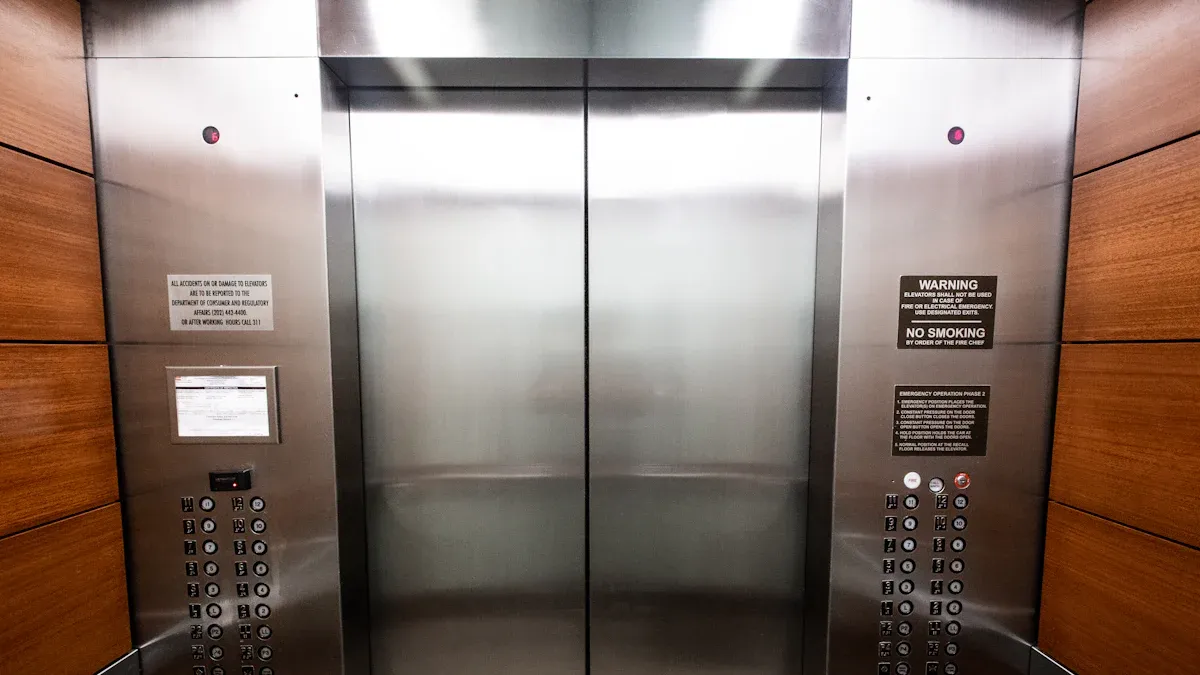
Choosing the right elevator type depends on the building’s function and expected traffic. Each type offers unique mechanisms and advantages. The table below summarizes the most common elevator types, their features, and typical applications:
| Elevator Type | Mechanism / Description | Advantages / Features | Typical Usage / Building Type |
|---|---|---|---|
| Passenger Elevators | Standard elevators for people transport | Reliable, customizable, suitable for various building types | Commercial offices, hospitals, residential buildings |
| Service Elevators | Transport goods and equipment | Higher weight capacity, robust design | Hotels, hospitals, commercial buildings |
| Freight Elevators | Heavy-duty elevators for large loads | Can carry up to 8,000+ pounds, reinforced for heavy use | Warehouses, factories, industrial and commercial sites |
| Dumbwaiters | Small elevators for moving objects like food, laundry | Space-saving, safety features, convenient for tight spaces | Restaurants, hotels, private homes, some residential |
| Geared Traction | Use gearbox with motor for slower, steady operation | Suitable for low- to mid-rise buildings, dependable, easy maintenance | Commercial offices, hotels, residential buildings |
| Gearless Traction | Motor directly drives pulley, faster and smoother | Energy efficient, quieter, fewer moving parts | Mid- to high-rise buildings |
| Hydraulic Elevators | Use fluid pressure and pistons | Cost-effective, smooth operation, suitable for low-rise buildings | Residential complexes, small commercial spaces |
| Conventional Hydraulic | Piston and cylinder system | Lower installation cost, space efficient, easy maintenance | Buildings 2-5 stories, residential and commercial |
| Roped Hydraulic | Combines ropes and pistons for longer travel | Faster, machine room above shaft, space-saving | Mid-rise buildings |
| Hole-less Hydraulic | No borehole needed, uses two pistons | Flexible installation, cost-effective, minimal maintenance | Small office buildings, residential complexes |
| Specialty Elevators | Custom solutions for unique needs | Efficient, space-saving, purpose-specific | Hospitals, industrial sites, high-end residential |
| Vacuum Elevators | Air pressure driven, no cables or pulleys | Compact, energy efficient, easy maintenance | Mid-rise residential buildings, small commercial |
Tip: Selecting the correct elevator type ensures efficient movement of people and goods, while also meeting safety and operational needs.
Main Performance Indicators and Specifications
Several key parameters distinguish elevator types and influence their suitability for different buildings:
- Mechanism of Operation: Hydraulic elevators use fluid pressure and a piston to move the car. Traction elevators rely on ropes and counterweights driven by a motor.
- Installation Requirements: Hydraulic models require a pit and a machine room at the shaft’s base. Traction elevators can be machine-room-less but need more vertical clearance.
- Speed and Performance: Traction elevators travel faster and provide smoother rides, making them ideal for buildings with more than five floors. Hydraulic elevators operate at slower speeds and suit low-rise structures.
- Maintenance and Cost: Hydraulic elevators need more frequent maintenance due to oil leaks and pump wear. Traction elevators have fewer moving parts but require more complex maintenance.
- Energy Efficiency: Traction elevators offer greater energy efficiency, especially with regenerative drives. Hydraulic elevators consume more energy and may pose environmental risks from oil leaks.
- Safety and Accessibility: Both types include emergency brakes and backup systems. Hydraulic elevators can be manually lowered during power outages, which benefits residential settings.
| Parameter | Traction Elevators | Hydraulic Elevators |
|---|---|---|
| Mechanism of Operation | Use steel ropes and counterweights driven by an electric motor and sheave. | Use a fluid-driven piston (hydraulic fluid pumped into a cylinder) to raise and lower the car. |
| Speed and Travel Height | Higher speeds (up to 1000+ feet/min), suitable for mid- to high-rise buildings. | Slower speeds (generally below 200 feet/min), limited to low-rise buildings (up to 6-8 floors). |
| Energy Efficiency | More energy-efficient due to counterweights; gearless types have regenerative drives. | Less energy-efficient; motor continuously pumps fluid; potential environmental risks from leaks. |
| Installation Space | Requires overhead machine room or MRL system; needs more vertical clearance. | Requires less overhead space but needs a deep pit for the piston; simpler machinery at shaft base. |
| Maintenance and Costs | More complex maintenance (ropes, sheaves, gearboxes); higher initial cost but lower operating cost. | Simpler mechanical system; lower installation cost; higher energy and maintenance costs due to fluid handling. |
| Ride Comfort and Noise | Smoother, quieter ride especially with gearless models. | Generally noisier and less smooth due to piston movement and fluid pressure fluctuations. |
| Safety Features | Multiple steel cables provide redundancy; advanced electronic controls. | Fewer moving parts; requires monitoring of fluid pressure and seals to prevent leaks. |
| Typical Applications | Mid- to high-rise commercial, residential, hospitals, hotels, corporate towers. | Low-rise office buildings, hotels, residential complexes, freight elevators for heavy loads. |
Selecting Elevator Capacity and Speed
Capacity and speed must match the building’s height, usage, and expected traffic. Passenger elevators in high-rise buildings typically support around 4,000 lbs (about 1,814 kg), with some models reaching up to 6,000 lbs. Low-rise buildings often use elevators with capacities between 2,100 and 2,500 lbs, while mid-rise buildings require 3,000 to 4,000 lbs. Stronger machinery and reinforced structures support higher capacities in taller buildings.
Elevator speed varies based on building height and usage requirements. Tall buildings require high-speed elevators to reduce travel time. For example, express elevators in skyscrapers can reach speeds up to 3,300 feet per minute, while standard models in low-rise buildings operate at much lower speeds. High-traffic buildings such as offices and hotels benefit from faster elevators, while low-traffic buildings can use standard speeds. Designers must balance speed with energy consumption, maintenance needs, and passenger comfort.
| Factor | Impact on Elevator Speed and Design |
|---|---|
| Building Height | Tall buildings require high-speed elevators to reduce travel time; low-rise buildings typically use standard speeds. |
| Usage Patterns | High-traffic buildings (offices, hotels) benefit from faster elevators; low-traffic buildings can use standard speeds. |
| Energy Consumption | High-speed elevators consume more energy, requiring efficient designs to balance speed and sustainability. |
| Maintenance Needs | Faster elevators may have increased maintenance due to mechanical strain. |
| Building Design | High-speed elevators need robust shaft design and larger lobby spaces to handle traffic and ensure comfort. |
| Passenger Comfort | Smooth acceleration/deceleration and ride stability are critical for high-speed elevator comfort. |
| Architectural Integration | Elevator speed must be balanced with aesthetics, cost, and future adaptability to meet building needs. |
Note: Properly matching elevator capacity and speed to building requirements ensures safety, efficiency, and user satisfaction.
Elevator Site and Shaft Measurement Essentials
Required Measurements and Data Collection
Accurate shaft measurement forms the foundation of safe and efficient installation. Professionals collect several types of data to ensure proper fit and operation.
- They record precise shaft dimensions to confirm compatibility with equipment.
- Measurement teams assess verticality of shaft walls to prevent operational issues.
- Clearance between the car and shaft walls receives careful attention to avoid collisions.
- Teams measure at multiple shaft positions—top, middle, and bottom—to identify irregularities.
- High-precision tools such as laser rangefinders and verticality instruments improve accuracy.
- Trained personnel follow standardized methods for reliable results.
- Quality control includes repeated checks and detailed data recording.
Tip: Consistent and thorough measurement procedures reduce installation risks and support long-term reliability.
Impact of Shaft Dimensions and Building Constraints
Shaft dimensions play a decisive role in installation feasibility and user comfort. Residential projects often require shaft widths from 52 to 60 inches and depths from 52 to 66 inches. These measurements accommodate one or two passengers and sometimes wheelchair users. Compact models suit retrofit projects with limited space, minimizing structural changes. Shaft construction type—masonry, steel, or shaftwall—affects installation complexity and cost. Fire resistance requirements demand specific materials and designs, especially for multi-story buildings. Shaft size determines the type, size, and capacity of equipment that fits, influencing compliance with safety and accessibility standards. Early planning enables optimal placement and future-proofing, while inadequate sizing can limit functionality and comfort.
Avoiding Common Measurement Errors
Measurement errors can lead to costly delays and safety hazards. Teams must avoid relying on a single measurement point, as shafts may have local unevenness. Using outdated or low-precision tools increases risk of inaccurate data. Personnel without proper training may overlook critical details or misinterpret results. Failure to document measurements thoroughly can result in miscommunication with suppliers and contractors. Repeated checks and use of advanced instruments help prevent mistakes. Clear procedures and professional oversight ensure that installation proceeds smoothly and safely.
Elevator Technical and Installation Considerations
Control Systems and Machine Room Options
Modern elevator systems rely on advanced control technologies to optimize performance, safety, and user experience. Control systems have evolved from manual operation to sophisticated automation. The main types include:
- Manually-controlled systems, which require an operator and offer limited automation.
- Dual operation systems, allowing both manual and automatic modes for flexibility and cost savings.
- Signal operation systems, which simplify controls and reduce operator effort.
- Automatic-controlled systems, using relay logic or microprocessors to manage speed, position, and door operation for smoother rides.
- Destination dispatch systems, which assign passengers to specific cars based on their destination, reducing wait and travel times in high-rise buildings.
- Remote monitoring systems, providing real-time data for maintenance and performance optimization, minimizing downtime.
Control systems also differ by drive mechanism. The table below summarizes common drive types and their advantages:
| Type of Control System | Description | Advantages |
|---|---|---|
| Hydraulic Drive | Motor-driven oil moves a piston; best for low-rise buildings. | Simple, cost-effective, easy to maintain. |
| Motor Reducer Gear Drive | AC/DC motors drive gears and cables; used in mid-speed elevators. | Reliable, widely used, moderate speed. |
| Motor Direct Drive | Large motor directly drives the elevator; for high-speed use. | Smooth, high-speed, advanced control. |
| Linear Motor Drive | Induction or synchronous motors on shaft walls, no cables. | Innovative, not height-limited, high energy use. |
| Inorganic Room Drive | Traction motor on the car, no machine room needed. | Space-saving, ideal for small or personal use. |
Machine room options also impact building design and cost. Machine room-less (MRL) elevators integrate machinery within the shaft, saving valuable space and reducing construction costs. MRL designs appeal to architects and contractors who want to maximize usable floor area. However, maintenance can be more challenging due to limited access, and MRL elevators may have a shorter lifespan compared to traditional systems. Traditional machine room elevators require more space but offer easier maintenance and longer service life. The choice depends on building height, available space, and long-term operational needs.
Note: Selecting the right control system and machine room configuration ensures efficient operation, cost savings, and easier integration with building architecture.
Installation Requirements and Site Preparation
Proper installation begins with careful planning and site preparation. Commercial buildings must comply with strict standards to ensure safety and accessibility. Key requirements include:
- Elevators are mandatory in buildings with three or more stories or where each floor exceeds 3,000 square feet.
- Doors must be at least 36 inches wide to accommodate wheelchairs.
- Cabins should measure at least 51 inches deep and 68 inches wide for side-door placement.
- Doors must fully open, remain open for at least three seconds, and feature obstruction sensors.
- Control buttons must be at least 0.75 inches in diameter and positioned 42 inches above the floor.
- Control panels require Braille indicators and audible signals for floor arrival.
- Two-way intercoms and emergency controls must be accessible.
- Elevators must be easily reached from public areas such as lobbies.
Site preparation involves several steps:
- Confirm the building’s structural feasibility, including shaft location and load-bearing capacity.
- Set a realistic budget covering framing, electrical work, permits, and finishing materials.
- Secure all necessary permits and approvals from local authorities.
- Prepare the site by constructing the shaft, pit, and machine room if required.
- Remove old equipment for modernization projects and ensure the area meets current codes.
- Schedule electrical work and approve custom finishes early to avoid delays.
- Coordinate timelines with contractors to minimize disruption.
- Conduct thorough inspections and testing before use, including training for key personnel.
Tip: Early coordination with suppliers and contractors streamlines the installation process and helps avoid costly delays.
Addressing Technical and Site Challenges
Technical challenges often arise during elevator installation. Common issues include:
- Inadequate planning or design, such as choosing the wrong type or capacity, or failing to meet building codes.
- Incorrect shaft dimensions or misalignment, leading to structural problems and project delays.
- Overlooking electrical or mechanical requirements, which can cause power failures or inefficiencies.
- Ignoring safety and accessibility regulations, resulting in compliance violations.
- Selecting low-quality or incompatible components, increasing the risk of breakdowns.
- Poor coordination between contractors, causing miscommunication and rework.
- Skipping routine inspections and testing, which can hide defects and create safety hazards.
Project teams can address these challenges by conducting thorough site assessments, reviewing architectural plans, and maintaining open communication among all stakeholders. Regular inspections and adherence to a detailed scope of work ensure that the installation meets safety, accessibility, and operational standards.
Callout: Proactive planning, precise measurements, and strict adherence to codes help prevent most technical and site challenges during elevator installation.
Elevator Safety, Accessibility, and Compliance
Essential Safety Features and Emergency Preparedness
Modern elevator systems incorporate a range of safety features to protect passengers and ensure reliable operation. The following table highlights critical components found in contemporary installations:
| Safety Feature | Description |
|---|---|
| Emergency Braking System | Automatic brakes activate if the elevator descends too quickly, preventing free falls. |
| Door Sensors and Reopening | Infrared or pressure sensors detect obstructions, reopening doors to prevent injury. |
| Emergency Communication System | Two-way intercoms connect passengers to emergency responders, with visual and tactile options available. |
| Backup Power and Lighting | Battery systems maintain elevator operation or lighting during power outages. |
| Overspeed Governor | Monitors speed and triggers brakes if necessary. |
| Firefighter and Emergency Modes | Special controls allow manual operation during emergencies and automatic return during fire alarms. |
| Overload Sensors | Prevent operation if weight exceeds safe limits. |
| Regular Safety Inspections | Routine checks ensure all systems function and comply with codes. |
These features work together to minimize risks and support emergency preparedness. Regular inspections and maintenance remain essential for long-term safety.
Accessibility Requirements and User-Friendly Design
Elevator accessibility standards ensure that all users, including those with disabilities, can travel independently and safely. Key requirements include:
- Doors must provide a minimum clear width of 36 inches to accommodate wheelchairs.
- Control panels should be positioned between 15 and 48 inches above the floor, accessible to seated users.
- Buttons require tactile and braille labels, with backlighting for visibility.
- Audible signals announce floor arrivals and direction, assisting visually impaired passengers.
- Spacious cabins allow for a 60-inch turning radius, supporting mobility aids.
- Emergency communication systems offer visual and tactile feedback for users with hearing or speech impairments.
- Non-slip flooring enhances safety for all passengers.
Inclusive design features, such as touchless controls and smartphone integration, further improve usability and hygiene. Compliance with ADA and international standards like ISO 4190 and EN 81-70 ensures legal and ethical accessibility.
Meeting Local Regulations and Standards
Elevator installation and operation must comply with national and local regulations. Authorities enforce standards such as ASME A17.1 and CSA B44, covering design, inspection, and maintenance. Local laws require annual inspections and operating certificates, with strict penalties for non-compliance. For example, failure to meet safety standards can result in fines, project delays, or even criminal charges. Property managers must stay informed about updates to codes and coordinate with licensed inspectors. Adhering to these regulations protects users, maintains property value, and avoids legal complications.
Elevator Preparation and Ordering Process
Steps to Prepare for Ordering
Successful elevator projects begin with early planning. Teams engage suppliers before finalizing architectural drawings. This approach prevents layout conflicts and structural issues. They confirm specifications, including type, size, and custom features, to avoid manufacturing delays. Coordination with electricians and other trades ensures proper site preparation and power requirements. Project managers set realistic timelines, allowing for lead times and inspections. Site preparation includes framing the hoistway, pouring the pit, and installing dedicated electrical circuits. After finalizing floor plans and specifications, teams place the order. Manufacturing lead times range from 8 weeks for hydraulic models to 25 weeks for traction systems. Delivery and installation follow rough framing, with final inspections and commissioning before use.
Early preparation helps identify modernization needs, secures financing, and prevents unexpected breakdowns.
Ensuring Data Accuracy and Documentation
Accurate documentation supports a smooth ordering process. Technicians use mobile apps with offline capabilities to record data on-site. Real-time schedule updates and automated notifications keep everyone informed. Digitized service reports improve the speed and accuracy of documentation. Centralized dispatching tools manage work orders efficiently, reducing manual errors. Customer portals allow clients to approve estimates and access order details, promoting transparency.
| Method Category | Description |
|---|---|
| Centralized Customer Data | Stores all information in one place, reducing duplication and errors. |
| Automated Estimates | Creates quick and accurate estimates, minimizing manual mistakes. |
| Customer Portals | Enables clients to review and approve orders, ensuring accuracy and transparency. |
Coordinating with Suppliers and Contractors
Clear communication with suppliers and contractors ensures project success. Teams align installation schedules, delivery logistics, and site readiness. They coordinate crane and truck arrangements for timely delivery. Electricians install required circuits, while fire safety systems meet code requirements. Regular updates and transparent communication reduce misunderstandings and keep the project on track.
Proactive coordination leads to smoother execution and better long-term value.
Elevator Special Cases and Practical Tips
Solutions for Unique Building Scenarios
Many buildings present unique challenges that require specialized vertical transportation solutions.
- Hotels and hospitals often use service elevators to move supplies and housekeeping carts discreetly, keeping passenger areas clear.
- Warehouses and industrial facilities rely on freight elevators with reinforced structures to transport heavy loads and large equipment safely.
- Wheelchair lifts provide accessibility in locations where installing a full passenger elevator is impractical, ensuring compliance with ADA standards.
- Restaurants and libraries benefit from dumbwaiters, which efficiently move small goods between floors and reduce manual labor.
Tip: Selecting the right solution for each scenario improves operational efficiency and supports regulatory compliance.
Practical Advice for a Smooth Elevator Purchase
A successful purchase begins with clear project goals and thorough site assessment. Buyers should consult with experienced suppliers early to identify the best fit for their building’s needs. They must verify shaft measurements, confirm load requirements, and review local codes. Comparing service contracts and warranty options helps avoid unexpected costs. Transparent communication with contractors and suppliers ensures timely delivery and installation.
Callout: Early planning and detailed documentation prevent costly mistakes and project delays.
After-Sales Service and Maintenance Planning
Manufacturers offer a range of after-sales services to maximize reliability and safety. Configuration Lifecycle Management centralizes data, enabling technicians to arrive with the correct parts and streamline service calls. Standard and customizable maintenance contracts address unique building needs, with options for response times, coverage, and communication tools. Annual safety tests, extensive part inspections, and highly trained technicians support long-term performance. Technology investments, such as real-time scheduling and 24/7 digital monitoring, reduce callbacks and downtime. Regular maintenance preserves mechanical integrity, extends lifespan up to 20 years, and ensures compliance with safety standards. Neglecting routine care increases the risk of breakdowns, costly repairs, and safety hazards.
| Factor | Impact on Maintenance and Longevity |
|---|---|
| Manufacturer Recommendations | Following OEM guidelines prevents breakdowns and extends lifespan. |
| Usage Frequency | High usage requires more frequent maintenance to ensure safety. |
| Elevator Age | New and old elevators need more frequent checks; middle lifecycle is most reliable. |
| Operating Environment | Industrial/commercial settings require tailored maintenance due to heavier loads. |
| Elevator Type | Hydraulic and traction elevators have different maintenance needs. |
| Benefits of Regular Maintenance | Enhanced safety, reduced downtime, and cost savings over time. |
A successful elevator purchase depends on careful planning, accurate measurements, and clear communication with suppliers. Regular maintenance and compliance with safety standards ensure reliable operation and long-term value. By prioritizing technical details and safety features, building owners create a secure and efficient environment for all users.
FAQ
What documents do suppliers need before elevator installation?
Suppliers need shaft measurements, building plans, electrical diagrams, and compliance certificates. Accurate documentation helps prevent delays and ensures proper installation.
How often should elevators receive maintenance?
Elevators require maintenance every three to six months. Regular inspections improve safety, reduce downtime, and extend equipment lifespan.
Can elevators be customized for unique building designs?
Manufacturers offer custom cabin sizes, finishes, and control panels. They adapt elevator specifications to meet architectural requirements and user needs.